Dental Implants vs Bridge: Which One Actually Lasts Longer?
Quick Answer
Dental implants last significantly longer than bridges. Clinical studies show implants have 10-year survival rates of roughly 94–98%, often functioning for 20–30 years or even a lifetime with proper care, while dental bridges have 10-year survival rates of approximately 72–87% and typically need replacement every 10–15 years. The longevity gap exists mainly because implants are anchored directly into the jawbone and don't rely on neighboring teeth for support, while bridges depend entirely on the long-term health of the teeth on either side of the gap.
If you're missing one or more teeth and trying to decide between a dental implant and a dental bridge, longevity is usually the deciding factor patients care about most — understandably, since this isn't a treatment most people want to repeat every decade.
Here's what the clinical research actually shows, and why the two options age so differently.
Dental Implants vs Bridge: Survival Rates at a Glance
| Dental Implant | Dental Bridge | |
|---|---|---|
| 10-year survival rate | ~94–98% | ~72–87% |
| Typical lifespan | 20–30 years, often a lifetime | 10–15 years |
| What gets replaced over time | Crown only, every 10–15 years; post often lasts a lifetime | Entire bridge, every 10–15 years |
| Effect on neighboring teeth | None — stands independently | Requires grinding down healthy adjacent teeth |
| Effect on jawbone | Preserves bone through osseointegration | Does not stimulate bone; bone loss can continue |
| Main failure cause | Poor bone quality, smoking, infection (peri-implantitis) | Decay or fracture of supporting (abutment) teeth |
Why Do Dental Implants Last Longer Than Bridges?
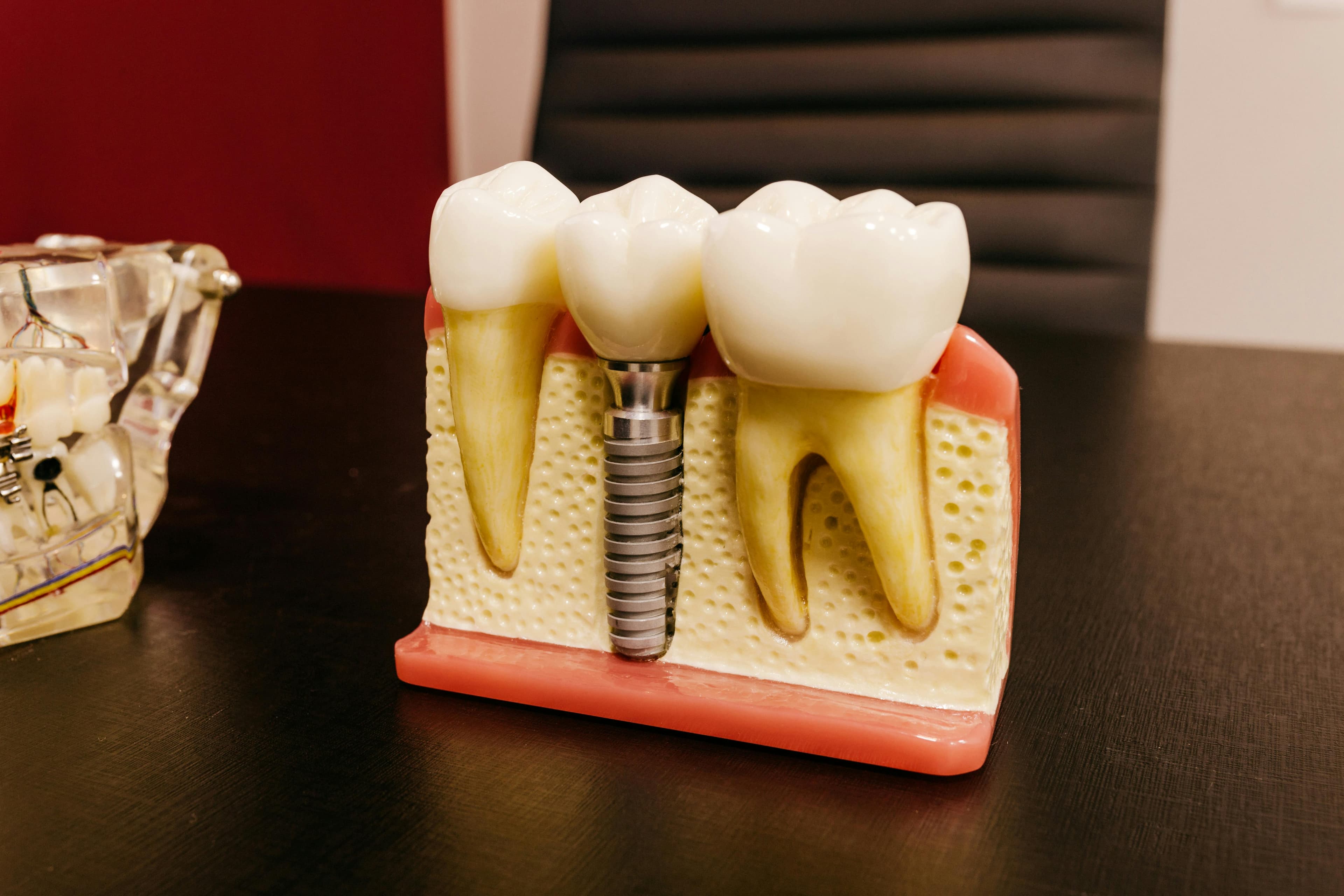
Implants don't depend on other teeth to survive. A dental implant consists of a titanium post placed directly into the jawbone, which fuses with the bone through a biological process called osseointegration. Because the implant functions like an artificial root standing entirely on its own, its survival isn't tied to the health of any other tooth in your mouth.
Bridges are only as strong as their weakest link. A bridge has to be anchored to the natural teeth on either side of the gap, called abutment teeth. Your dentist has to reduce these healthy teeth to make room for the bridge's supporting crowns, which permanently removes protective enamel and increases the chewing load those teeth must bear every day. If either abutment tooth later develops decay, a fracture, or gum disease, the entire bridge can fail — even if the bridge itself was made and fitted perfectly.
Implants preserve jawbone; bridges don't. Because an implant integrates directly into the bone, it provides ongoing stimulation that helps maintain bone density in that area, much like a natural tooth root would. A bridge sits on top of the gum and doesn't transmit this stimulation, so the jawbone underneath the gap can continue to gradually resorb over time even after the bridge is placed.
Bridges trap bacteria more easily. The area underneath the artificial tooth in a bridge (called the pontic) and around the abutment crowns is more prone to plaque buildup, since it requires extra cleaning with floss threaders or water flossers that many patients skip. This raises the long-term risk of decay at the bridge margins and gum disease around the supporting teeth.
What Do the Actual Survival Rate Studies Show?
This is where the comparison becomes very clear. Research directly comparing the two treatments found that dental implants have a 10-year survival rate of approximately 94–98%, compared to roughly 72–87% for dental bridges over the same period. Other large-scale clinical reviews report dental implant success rates consistently over 90% at 10 years, and in some long-term studies, implants maintain success rates of 95–98% even when followed for 40 to 50 years.
Bridges, by comparison, have a published average lifespan of around 10.1 years according to American Dental Association data, largely due to weakening of the tooth structure supporting them over time. Bridge longevity also drops further in certain situations: when one of the abutment teeth has previously had root canal treatment, or when the bridge needs to span more than one missing tooth, success rates decline even more.
Does the Crown on an Implant Wear Out Too?
Yes — it's important to understand that "implants last a lifetime" usually refers to the titanium post itself, not necessarily the crown attached to it. The implant post can often last a lifetime once successfully integrated into the bone, but the visible crown on top may need replacement every 10–15 years due to normal wear, similar to how a natural tooth's enamel wears down over decades of use. The key advantage is that replacing just the crown on an existing, stable implant is a far simpler and less invasive procedure than replacing an entire bridge.
What Causes Each Option to Fail?
Dental implant failure is most commonly linked to poor bone quality or density, smoking (which significantly reduces healing and integration success), uncontrolled diabetes or other systemic health conditions, and peri-implantitis, an infection of the gum and bone around the implant caused by inadequate oral hygiene.
Dental bridge failure is most often caused by decay or fracture of the abutment teeth, loss of the bond or cement holding the bridge in place, bacterial buildup under the pontic leading to gum disease, and increased bite force from habits like teeth grinding that accelerate wear on both the bridge and the supporting teeth.
Is a Dental Implant Always the Better Choice?
Not necessarily for every patient, even though implants outperform bridges on pure longevity. Dental bridges remain a reasonable option when a patient doesn't have adequate jawbone for an implant and isn't able or willing to undergo bone grafting, when a faster treatment timeline is needed, since bridges can typically be completed within a few weeks compared to the multi-month implant integration process, or when certain medical conditions make implant surgery inadvisable.
In some cases, the two approaches are even combined: an implant-supported bridge anchors a multi-tooth bridge onto implants at either end instead of natural teeth, combining the bridge's design with the implant's independence from adjacent tooth health — a useful option when replacing several missing teeth in a row.
Dental Implants vs Bridge: Cost Considerations Over Time
Bridges typically cost less upfront, which makes them attractive initially. However, because bridges need replacement roughly every 10–15 years while a well-integrated implant post can last decades or a lifetime, the long-term cost picture often favors implants once you account for the cost of one or more bridge replacements over a 20–30 year period. The right financial comparison isn't the upfront price alone — it's the total cost across the years you expect to keep the restoration.
How Do You Know Which One Is Right for You?
The right choice depends on your bone health, the condition of the teeth next to the gap, your overall health, how soon you need the gap addressed, and your long-term priorities. A clinical exam with X-rays or a CBCT scan is the only reliable way to know whether you have sufficient bone for an implant, or whether bridge-supporting teeth are healthy enough to bear the long-term load a bridge requires.
The Aurévo Approach to Tooth Replacement
At Aurévo Advanced Dental Studio in Satellite, Ahmedabad, every tooth-replacement decision starts with a full diagnostic evaluation, including imaging to assess bone health and the condition of any teeth that would support a bridge, led jointly by Dr. Manini Parikh's restorative expertise and Dr. Malav Parikh's surgical and implant training. Rather than defaulting to one option, we walk you through the honest longevity, cost, and maintenance trade-offs for your specific case, so the choice you make is the right one for your mouth — not just the faster or cheaper one in the short term.
Trying to decide between a dental implant and a bridge? Book a consultation at Aurévo Advanced Dental Studio, Shivranjani Crossroads, Ahmedabad, to find out which option will genuinely serve you best long-term.
Frequently Asked Questions
This article is for informational purposes and does not replace an in-person dental evaluation. Implant survival rates, bridge longevity estimates, and complication percentages cited are based on published clinical studies and may not reflect individual outcomes, which depend on bone quality, oral hygiene, and overall health. Treatment recommendations should be made in consultation with a qualified dental specialist.
More Articles
Why Traditional Root Canals Fail Over Time — And Why Microscopic RCT Changes the Outcome
June 17, 2026
Full Mouth Rehabilitation in India: Complete Guide to Cost, Process, Candidates & Recovery
June 17, 2026
Veneers After Braces or Invisalign: Why Ahmedabad Patients Are Switching for the Final Smile Makeover
June 16, 2026